
One of the core pillars of GRAPP‑CAIB is the transferability of its research activity.
Our transfer activity is based on three main pillars: 1) development and evaluation of digital tools, 2) development, adaptation, and validation of questionnaires, and 3) development of clinical practice guidelines.
1. DIGITAL TOOLS
Digital Health (also known as eHealth) refers to “the use of information and communication technologies to improve health and related fields“. At GRAPP-caIB, we conduct research in the field of Digital Health through the design, development, and evaluation of digital tools. Our group primarily focuses on two types of digital tools:
- Digital tools aimed at individuals, with the goal of preventing or treating common health issues in our environment, such as diabetes or mental health problems.
- Digital tools aimed at health centers and managers, with the goal of helping them provide high-quality and safe healthcare.
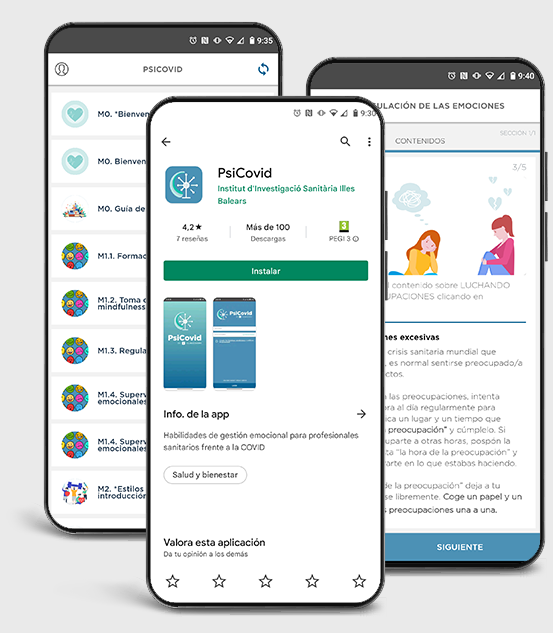
PsiCovid
- Name: PsiCovid
- Objective: to provide psychological support to frontline healthcare professionals during the COVID-19 pandemic through psychoeducational techniques (emotional management, mindfulness, lifestyle, social support, work stress, and burnout).
- Target Audience: Frontline healthcare professionals during the COVID-19 pandemic.
- Technological Basis: Smartphone app (Android and iOS).
- Principal Researchers: Ignacio Ricci Cabello, Maria Jesús Serrano, Mauro García Toro.
- Current Status: Evaluated and implemented.
- Currently available: Yes
- More information: https://grappcaib.es/psicovidapp/




e-pD-WORK
- Name: e-pD-WORK
- Objective: To prevent depression in the workplace through recommendations for maintaining a healthy lifestyle, improving sleep hygiene, enhancing social relationships, and promoting physical health, among other aspects.
- Targeted at: workers
- Technological base: multiplatform application (mobile, tablet, and computer)
- Principal Investigators: Juan Ángel Bellón Saameño (study coordinator), Alfonso Leiva (Principal Investigator in the Balearic Islands).
- Current status: Developed, in the evaluation phase.
- Currently available: Only clinical trial (currently in the recruitment phase).
- More information: https://epdwork.org/

2. QUESTIONNAIRE VALIDATION
In our studies, we use a range of tools to obtain results, such as questionnaires administered to study participants.
In some cases, these questionnaires were developed in other countries and require validation before being used in our context and in the Spanish population. Translation alone is not sufficient; the document must also undergo cultural adaptation and feasibility testing in the target population, while maintaining the original structure as far as possible. Validation also includes verifying that the questionnaire meets its intended purpose, ensuring reliability and simplicity, while remaining sensitive enough to detect and measure changes in the phenomenon under investigation.
PREOS-PC Questionnaire.
A self‑completed questionnaire by patients or service users, designed to comprehensively assess experiences and outcomes related to patient safety in ambulatory and primary care settings.
Originally developed for use in health centres in England, this questionnaire was adapted, translated, and validated by members of GRAPP‑CAIB for application in Spain. Currently available in both Spanish and Catalan.
More information:
- https://innovation.ox.ac.uk/outcome-measures/patient-reported-experiences-outcomes-safety-primary-care-preos-pc/
- https://bibliopro.org/buscador/4393/patient-reported-experiences-and-outcomes-of-safety-in-primary-care-version-espanola-corta
- Serrano-Ripoll MJ, Llobera J, Valderas JM, de Labry Lima AO, Fiol-deRoque MA, Ripoll J, Ricci-Cabello I. Cross-Cultural Adaptation, Validation, and Piloting of the Patient Reported Experiences and Outcomes of Safety in Primary Care Questionnaire for Its Use in Spain. J Patient Saf. 2022 Mar 1;18(2):102-110
Gut Feelings Questionnaire
The Gut Feelings Questionnaire (GFQ) is the only instrument specifically developed to evaluate the presence of a “sense of alarm” or a “sense of reassurance” during the diagnostic process in family medicine.
It was originally created in English and Dutch. Researchers from GRAPP‑CAIB carried out the validation of the questionnaire in Spanish and Catalan.
3. CLINICAL PRACTICE GUIDELINES
Clinical Practice Guidelines (CPGs) are a set of recommendations aimed at healthcare professionals, based on the best available scientific evidence. Their purpose is to facilitate decision-making, thereby reducing professional variability and ultimately improving clinical practice and healthcare quality. GRAPP-caIB has contributed to the drafting of some of these CPGs.
- Healthy Routes Program of the Balearic Islands.
Planas Juan T, Cabeza Irigoyen E, Munuera Arjona S, Mas Parera F, Fuster Truyol M, Garcia Salom E, et al. Palma: Ministry of Health; 2025. - Program for care and support during normal pregnancy.
Agüera Ortiz FJ, Alomar Castell M, Amato CC, Amengual Tomàs J, Aoukhiyad Lebrahimi L, Benedí Sánchez MT, et al. Palma: Balearic Islands Health Service; 2025. - Pediatric Surgical Calendar. Recommendations and Referral Criteria for Pediatric Surgery (2nd edition).
Cortada Gracia M, Darder Alorda MT, Huguet Rodríguez O, Marhuenda Irastorza C, Martín Delgado MI, Miranda Berrioategortua I, et al. Palma: Balearic Islands Health Service; 2020. - Assistance coordination for pregnant women, postpartum women, and newborns with SARS‑CoV‑2 infection or exposure.
Navarro Mateu M; Miralles Xamena J. Servicio de Salud de las Islas Baleares; 2020. Palma. ISBN 978-84-0925965-6. - Palliative Care Program of the Balearic Islands 2019–2023.
Castaño E, Llagostera M, Llobera J, Muñoz Y, Serrano C. Palma: Balearic Islands Health Service; 2019.

Pictures designed by Freepik (www.freepik.com)


